



Would you like to get detailed information? Contact us!
You can reach our support line 24/7. Our team will get back to you as soon as possible.Our clinics offer a comprehensive range of services to meet all your healthcare needs. You can consult our experienced team to get information about your treatments.
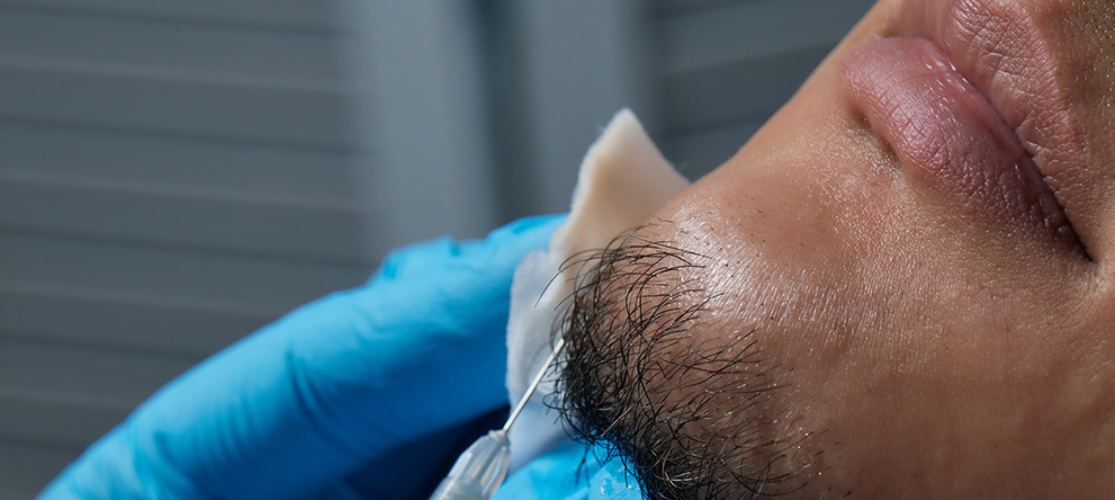
In recent years, the demand for beard transplantation and mustache transplantation has increased considerably. This operation is performed by transplanting hair follicles from the hairy areas to areas where there is sparse or no hair in the men's beard and mustache area.
Most of the requests for beard transplantation come from patients with beard problems such as sparseness or irregular distribution of beards. Before performing beard transplantation, care is taken to ensure that patients' hormone levels have reached a certain level. Therefore, we can say that the procedure can generally be applied from the age of 20-22. Additionally, people who prefer the appearance of 1-2 day stubble or want to grow their sideburns may consider beard transplantation to complete their missing or irregular beard. So, this operation is suitable for both those who have no beard and those who have sparse beards.
For men, beard is considered an integral part of their face. It is also an aesthetic accessory. A beard can help a man express himself the way he wants. However, it may not always be easy to achieve the desired beard look. This can become a big problem for many men. “Men cannot be without beards, men can have beards.” Social taboos such as may affect men's approach to beards. For this reason, many men resort to beard transplantation methods.
There are many reasons underlying the need for beard transplantation. The development of beards depends on male hormones. Sometimes, due to genetic factors, health problems, accidents or scars, sparsity, open areas or irregular appearance may occur in the beard area. Even acne scars during adolescence can trigger this problem. This is an important problem for men who care about beards.
The stubble fashion, which has become popular in recent years, has been a difficult trend to implement for those who have beard problems. This can cause serious self-esteem issues among men. However, sparse or missing beard is generally not a health problem. It triggers more of an aesthetic concern. It is also possible for those who make this issue a serious problem to experience psychological problems. Beard transplantation offered by aesthetic applications offers a permanent solution to men who want to deal with this problem.
Beard transplantation, like hair transplantation, aims to create a person's beard by transplanting hair follicles taken from another part of the body to problem areas in the beard area. This method can be applied successfully to people who never grow a beard or to people with sparse beards. Especially men with sparse beards often consider beard transplantation.
Since local anesthesia is used during the beard transplantation process, there is no feeling of pain. Since the FUE technique is used in beard transplantation as well as in hair transplantation, the procedure is performed extremely comfortably. With this technique, hair follicles taken from areas that do not tend to shed are transplanted to the beard area.
If the person to undergo beard transplantation has regional beard loss, environmental beard density is evaluated and an appropriate transplantation plan is created. In cases where the beard is completely missing, generally between 1000 and 3000 hair follicles can be transplanted by adjusting the limit and density according to the person's wishes. A meaningful restoration of the beard can be achieved by transplanting a total of 1000 hair follicles to someone who does not have a beard at all, with a distribution of 100 follicles to the sideburn area and 400 follicles to the chin and mustache area.
There are two different hair transplantation techniques used for beard transplantation: Direct Hair Root Transplantation (DHI) and Follicular Unit Extraction (FUE). Both techniques involve taking individual grafts (follicular units) from the donor area at the back of the head and transplanting them to the desired area on the face.
The DHI technique involves the surgeon taking hair follicles one by one and then transplanting them to the desired areas one by one with a tool called Choi Pen immediately after collection.
In the FUE technique, after removing the hair follicles one by one, the surgeon opens micro incisions in the target area and places the previously collected hair follicles into these incisions.
Both techniques are gentle procedures and do not cause pain as they are performed under local anesthesia. Beard transplantation techniques do not require incisions or stitches, so recovery time is short. You can create your dream beard hair transplantation plan by talking to your surgeon about the density and shape of the beard you want. If your donor area is suitable, you can take steps to have the thick and well-groomed beard you want.
 3 days
 Transfer Services
 Accommodation Options
 Nurse / Assistant Support
 1 Year Follow Up
Treatments are planned individually. You need to share information about your treatment with us so that we can provide you with correct planning. In particular, your photographs, x-rays, tests and previous health information are necessary for us to help you. After your information reaches us, your health consultant will contact you as soon as possible.
A beard transplant is a cosmetic procedure where hair follicles are taken from another part of the body (usually the scalp) and transplanted to the beard area to create a fuller, thicker beard.
Hair follicles are harvested from the donor area (typically the back of the scalp) using methods like Follicular Unit Extraction (FUE) or Follicular Unit Transplantation (FUT). These follicles are then implanted into the beard area in the desired pattern.
The procedure can take anywhere from 4 to 8 hours, depending on the number of grafts needed.
Local anesthesia is used during the procedure to minimize discomfort. Patients might experience mild discomfort or soreness after the procedure, which typically subsides within a few days.
Initial growth can be seen in about 3 to 4 months, with full results typically visible after 9 to 12 months. It's common for transplanted hairs to fall out after a few weeks before new growth begins.
Most patients can return to normal activities within a few days. Full recovery, including the time it takes for the transplanted follicles to establish and new hair to grow, can take several months.
Yes, if done by an experienced surgeon, the transplanted beard will look natural. The surgeon will consider factors like hair direction, angle, and density to ensure a natural appearance.
Potential risks include infection, scarring, and temporary swelling or redness. However, these are generally rare and mild when the procedure is performed by a skilled professional.
Ideal candidates are individuals with sufficient donor hair and realistic expectations about the results. Those with patchy beards, scars, or areas where hair doesn't grow can benefit from the procedure.
Post-procedure care includes following the surgeon's instructions, which may involve avoiding certain activities, taking prescribed medications, and attending follow-up appointments to monitor progress.
Shaving should be avoided for at least 10 to 14 days after the procedure to allow the transplanted follicles to settle. Your surgeon will provide specific guidelines based on your case.
Yes, beard transplants can be used to cover scars and create a more uniform appearance. Your surgeon will evaluate the scar and determine the best approach.
Yes, once the transplanted hair follicles establish themselves in the new location, they will grow permanently. Regular grooming and maintenance will be needed, just like natural facial hair.